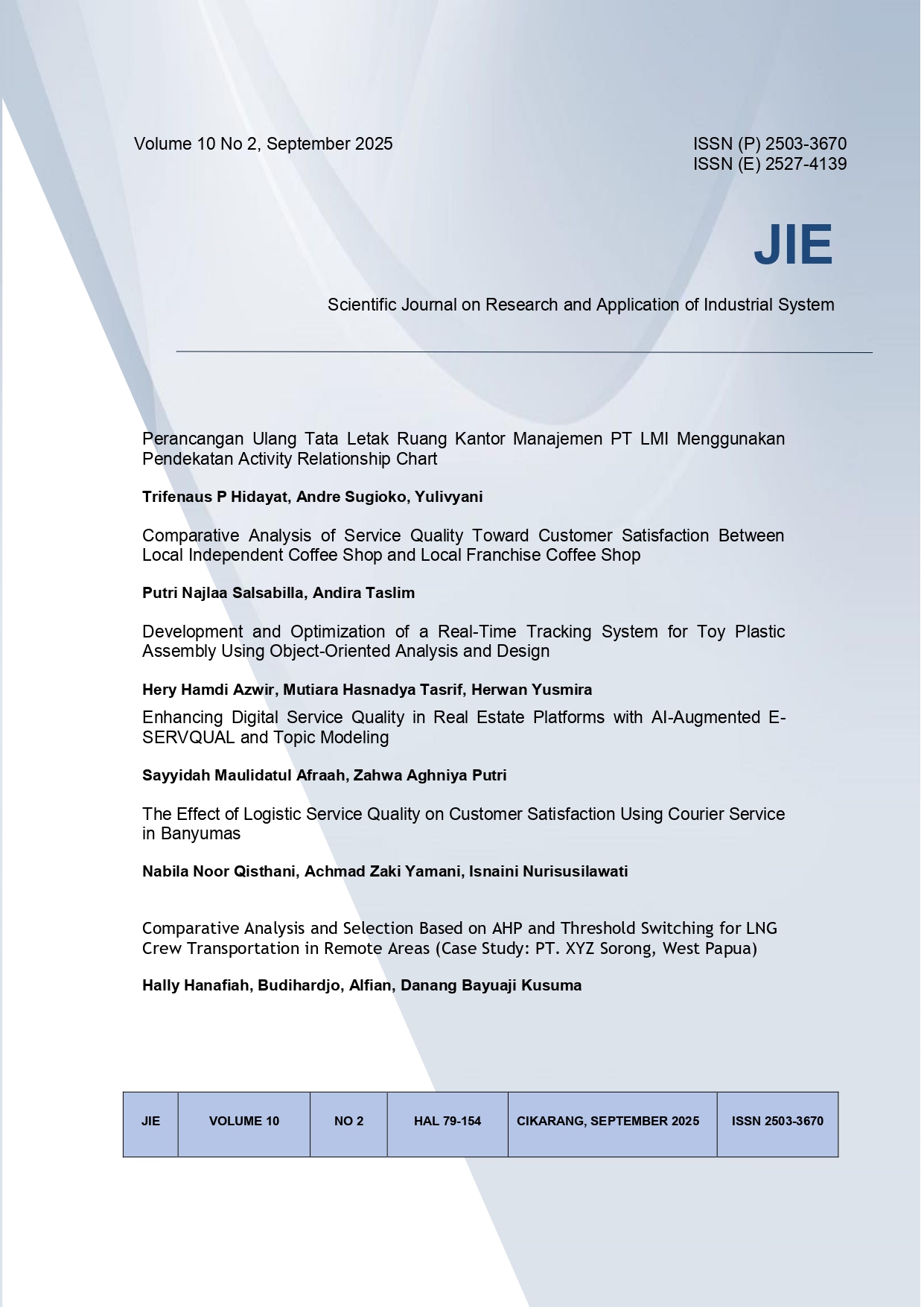
Comparative Analysis and Selection Based on AHP and Threshold Switching for LNG Crew Transportation in Remote Areas (Case Study: PT. XYZ Sorong, West Papua)
DOI:
https://doi.org/10.33021/jie.v10i2.6746Kata Kunci:
Fast Cruising Vessel, AHP, Crew Transportation, descriptive-comparative method, transportation costsAbstrak
Crew transportation plays a crucial role in ensuring the smooth operation of the Liquid Natural Gas (LNG) facility in West Papua. Current transportation relies on a combination of Dash 8 aircraft from Sorong to Babo, followed by small vessels to the LNG site. The challenges faced include dependence on weather conditions and ground infrastructure, which pose operational risks. This study aims to evaluate the effectiveness of the Fast Cruising Vessel (FCV) mode as a more efficient and reliable alternative for crew transportation. A descriptive-comparative method was used with the Analytic Hierarchy Process (AHP) approach and supported by a cost-efficiency threshold switching analysis. The assessment was conducted on eight main criteria, including travel time, cost, capacity, risk, comfort, flexibility, and infrastructure requirements. Data were obtained from technical documents and questionnaires from energy logistics practitioners. The AHP results showed that the FCV Damen Fast Ferry 4212 had the highest score (0.309), while the threshold switching calculation showed that the FCV mode resulted in cost savings of more than 80%, far exceeding the 25% threshold for modal shift feasibility. With minimal port infrastructure requirements and high flexibility, the FCV mode is considered the most technically, economically, and operationally feasible to support LNG crew rotations in remote areas. This study contributes to decision-making regarding maritime logistics strategies in remote areas, recommending FCVs as an efficient and reliable solution.
Referensi
1. Ahlan, M., Priyanto, S., & Utomo, S. H. T. (2024). Cost Comparison Analysis Between Maritime Intermodal and Road Mode Freight Transport in Java Island, Indonesia. International Journal of Transport Development and Integration, 8(2), 271–281. https://doi.org/10.18280/ijtdi.080206
2. Akhrouf, M., Medjamia, H., & Bessou, M. (2024). An AHP-Based Approach to Selecting a Priority Public Transportation Mode for Investment. International Journal of the Analytic Hierarchy Process, 15(3). https://doi.org/10.13033/ijahp.v15i3.1150
3. l-Mekhlafi, A.-B. A., Isha, A. S. N., Chileshe, N., Abdulrab, M., Kineber, A. F., & Ajmal, M. (2021). Impact of Safety Culture Implementation on Driving Performance among Oil and Gas Tanker Drivers: A Partial Least Squares Structural Equation Modelling (PLS-SEM) Approach. Sustainability, 13(16), 8886. https://doi.org/10.3390/su13168886
4. Aparicio, J. T., Arsenio, E., & Henriques, R. (2022). Assessing robustness in multimodal transportation systems: A case study in Lisbon. European Transport Research Review, 14(1), 28. https://doi.org/10.1186/s12544-022-00552-3
5. Archetti, C., Peirano, L., & Speranza, M. G. (2022). Optimization in multimodal freight transportation problems: A Survey. European Journal of Operational Research, 299(1), 1–20. https://doi.org/10.1016/j.ejor.2021.07.031
6. Aria, M., Khazim, I., Ilyas, M., Kekalih, A., & Fuady, A. (2024). Work-Related Fatigue Among Indonesian Offshore Oil and Gas Workers. Occupational Medicine, 74(5), 364–369. https://doi.org/10.1093/occmed/kqae040
7. Bailey, R. E., Kramer, L. J., Kennedy, K. D., Stephens, C. L., & Etherington, T. J. (2017). An assessment of reduced crew and single pilot operations in commercial transport aircraft operations. 2017 IEEE/AIAA 36th Digital Avionics Systems Conference (DASC), 1–15. https://doi.org/10.1109/DASC.2017.8101988
8. Baric, D., & Zeljko, L. (2021). Multi-Criteria Decision-Making on Road Transport Vehicles by the AHP Method. The Archives of Automotive Engineering – Archiwum Motoryzacji, 94(4), 17–26. https://doi.org/10.14669/AM.VOL94.ART2
9. Baykasoğlu, A., Subulan, K., Taşan, A. S., & Dudaklı, N. (2019). A review of fleet planning problems in single and multimodal transportation systems. Transportmetrica A: Transport Science, 15(2), 631–697. https://doi.org/10.1080/23249935.2018.1523249
10. Binsfeld, T., Hamdan, S., Jouini, O., & Gast, J. (2025). On the optimization of green multimodal transportation: A case study of the West German canal system. Annals of Operations Research, 351(1), 667–726. https://doi.org/10.1007/s10479-024-06075-5
11. Chen, W., & Huang, S. (2018). Evaluating Flight Crew Performance by a Bayesian Network Model. Entropy, 20(3), 178. https://doi.org/10.3390/e20030178
12. Chopra, S. (2019). Supply Chain Management: Strategy, Planning, and Operation (7th ed.). Pearson Education. https://books.google.co.id/books?id=l6oItAEACAAJ
13. Conticelli, E., Gobbi, G., Saavedra Rosas, P. I., & Tondelli, S. (2021). Assessing the Performance of Modal Interchange for Ensuring Seamless and Sustainable Mobility in European Cities. Sustainability, 13(2), 1001. https://doi.org/10.3390/su13021001
14. Dalgic, Y., Lazakis, I., & Turan, O. (2015). Investigation of Optimum Crew Transfer Vessel Fleet for Offshore Wind Farm Maintenance Operations. Wind Engineering, 39(1), 31–52. https://doi.org/10.1260/0309-524X.39.1.31
15. Damodaran, A. (2009). The Investment Principle: Estimating Hurdle Rates. Stern School of Business, New York University. https://pages.stern.nyu.edu/~adamodar/pdfiles/cfovhds/invN.pdf
16. Ebrahimi, S., & Bridgelall, R. (2021). A fuzzy Delphi analytic hierarchy model to rank factors influencing public transit mode choice: A case study. Research in Transportation Business & Management, 39, 100496. https://doi.org/10.1016/j.rtbm.2020.100496
17. Elbert, R., Müller, J. P., & Rentschler, J. (2020). Tactical network planning and design in multimodal transportation – A systematic literature review. Research in Transportation Business & Management, 35, 100462. https://doi.org/10.1016/j.rtbm.2020.100462
18. El-Thalji, I. (2024). Exploring More Sustainable Offshore Logistics Scenarios Using Shared Resources: A Multi-Stakeholder Perspective. Logistics, 8(4), 101.
https://doi.org/10.3390/logistics8040101
19. Fale, M., Wang, Y., Rupnik, B., Kramberger, T., & Vizinger, T. (2025). Systematic Review of Transportation Choice Modeling. Applied Sciences, 15(17), 9235.
https://doi.org/10.3390/app15179235
20. Fenner, D. (2019). Western New Guinea: Papua and West Papua Provinces of Indonesia. In World Seas: An Environmental Evaluation (pp. 875–888). Elsevier. https://doi.org/10.1016/B978-0-08-100853-9.00048-8
21. Forman, E. H., & Gass, S. I. (2001). The Analytic Hierarchy Process—An Exposition. Operations Research, 49(4), 469–486. https://doi.org/10.1287/opre.49.4.469.11231
22. Ghosh, S., Ramamoorthy, L., & Pottakat, B. (2021). Impact of Structured Clinical Handover Protocol on Communication and Patient Satisfaction. Journal of Patient Experience, 8, 2374373521997733. https://doi.org/10.1177/2374373521997733
23. Gigerenzer, G., & Gaissmaier, W. (2011). Heuristic Decision Making. Annual Review of Psychology, 62(1), 451–482. https://doi.org/10.1146/annurev-psych-120709-145346
24. Gössling, S., Neger, C., Steiger, R., & Bell, R. (2023). Weather, climate change, and transport: A review. Natural Hazards, 118(2), 1341–1360. https://doi.org/10.1007/s11069-023-06054-2
25. Graham, Ian. (2010). Working conditions of contract workers in the oil and gas industries (ILO Working Papers No. 276; pp. 1–97). International Labour Organization. https://www.ilo.org/publications/working-conditions-contract-workers-oil-and-gas-industries
26. Haase, M. (2016). Energy-efficient large medium-speed catamarans: Hull form design by full-scale CFD simulations. Ship Technology Research, 63(2), 133–134. https://doi.org/10.1080/09377255.2016.1208974
27. Hakola, T., Niemelä, P., Rönnberg, S., & Ropponen, A. (2021). Longer Work Shifts, Faster Forward Rotation—More Sleep and More Alert in Aircraft Inspection. International Journal of Environmental Research and Public Health, 18(15), 8105. https://doi.org/10.3390/ijerph18158105
28. Hansson, J., Pettersson, F., Svensson, H., & Wretstrand, A. (2019). Preferences in regional public transport: A literature review. European Transport Research Review, 11(1), 38. https://doi.org/10.1186/s12544-019-0374-4
29. Hofmann, D. A., & Stetzer, A. (1996). A Cross-Level Investigation of Factors Influencing Unsafe Behaviors And Accidents. Personnel Psychology, 49(2), 307–339. https://doi.org/10.1111/j.1744-6570.1996.tb01802.x
30. Hruška, R., Kmetík, M., & Chocholáč, J. (2021). Selection of the Transport Mode Using the AHP Method Within Distribution Logistics of Motor Fuels. Promet - Traffic&Transportation, 33(6), 905–917. https://doi.org/10.7307/ptt.v33i6.3940
31. Hu, X., Zhao, L., & Wang, W. (2015). Impact of perceptions of bus service performance on mode choice preference. Advances in Mechanical Engineering, 7(3), 1687814015573826. https://doi.org/10.1177/1687814015573826
32. Hystad, S. W., Saus, E.-R., Sætrevik, B., & Eid, J. (2013). Fatigue in seafarers working in the offshore oil and gas re-supply industry: Effects of safety climate, psychosocial work environment and shift arrangement. International Maritime Health, 64(2), 72–79.
33. Ishizaka, A., & Mu, E. (2023). What is so special about the analytic hierarchy and network process? Annals of Operations Research, 326(2), 625–634. https://doi.org/10.1007/s10479-023-05412-4
34. Kabashkin, I. (2023). Model of Multi Criteria Decision-Making for Selection of Transportation Alternatives on the Base of Transport Needs Hierarchy Framework and Application of Petri Net. Sustainability, 15(16), 12444. https://doi.org/10.3390/su151612444
35. Kogler, C., & Rauch, P. (2018). Discrete event simulation of multimodal and unimodal transportation in the wood supply chain: A literature review. Silva Fennica, 52(4). https://doi.org/10.14214/sf.9984
36. Krüger, N. A., & Vierth, I. (2015). Precautionary and operational costs of freight train delays: A case study of a Swedish grocery company. European Transport Research Review, 7(1), 6. https://doi.org/10.1007/s12544-015-0155-7
37. Leggett, D. (2004). Chemical reactivity assessments in R&D. Journal of Hazardous Materials, 115(1–3), 63–70. https://doi.org/10.1016/j.jhazmat.2004.05.008
38. Lin, D.-Y., & Tsai, M.-R. (2019). Integrated Crew Scheduling and Roster Problem for Trainmasters of Passenger Railway Transportation. IEEE Access, 7, 27362–27375. https://doi.org/10.1109/ACCESS.2019.2900028
39. Lin, Y.-K., Nguyen, T.-P., & Yeng, L. C.-L. (2022). Reliability evaluation of a stochastic multimodal transport network under time and budget considerations. Annals of Operations Research, 312(1), 369–387. https://doi.org/10.1007/s10479-019-03215-0
40. Makarova, I., Serikkaliyeva, A., Gubacheva, L., Mukhametdinov, E., Buyvol, P., Barinov, A., Shepelev, V., & Mavlyautdinova, G. (2023). The Role of Multimodal Transportation in Ensuring Sustainable Territorial Development: Review of Risks and Prospects. Sustainability, 15(7), 6309. https://doi.org/10.3390/su15076309
41. Mata, R., Von Helversen, B., & Rieskamp, J. (2011). When Easy Comes Hard: The Development of Adaptive Strategy Selection: The Development of Adaptive Strategy Selection. Child Development, 82(2), 687–700. https://doi.org/10.1111/j.1467-8624.2010.01535.x
42. Matthews, N., Joiner, K. F., & Smith, W. F. (2024). Stability Assessment of a Catamaran Using Sea Trials. Journal of Marine Science and Engineering, 12(8), 1436.
https://doi.org/10.3390/jmse12081436
43. Mohamed Said, A., Mahdi, D., & Zina, Z. (2024). Applying AHP and SCOR to assess road transport risk in the petroleum supply chain. Supply Chain Forum: An International Journal, 25(3), 380–406. https://doi.org/10.1080/16258312.2024.2328510
44. Moorhead, M., Armitage, L., & Skitmore, M. (2024). Real Estate Development Feasibility and Hurdle Rate Selection. Buildings, 14(4), 1045. https://doi.org/10.3390/buildings14041045
45. Moslem, S., Saraji, M. K., Mardani, A., Alkharabsheh, A., Duleba, S., & Esztergar-Kiss, D. (2023). A Systematic Review of Analytic Hierarchy Process Applications to Solve Transportation Problems: From 2003 to 2022. IEEE Access, 11, 11973–11990. https://doi.org/10.1109/ACCESS.2023.3234298
46. Nieuwenhuijsen, M. J. (Ed.). (2003). Exposure Assessment in Occupational and Environmental Epidemiology (1st ed.). Oxford University PressOxford. https://doi.org/10.1093/acprof:oso/9780198528616.001.0001
47. Payne, J. W., Bettman, J. R., & Johnson, E. J. (1993). The Adaptive Decision Maker (1st ed.). Cambridge University Press. https://doi.org/10.1017/CBO9781139173933
48. Phillips, R. O., Kecklund, G., Anund, A., & Sallinen, M. (2017). Fatigue in transport: A review of exposure, risks, checks and controls. Transport Reviews, 37(6), 742–766. https://doi.org/10.1080/01441647.2017.1349844
49. Radwanski, K., & Rutkowski, G. (2022). An Analysis of the Risks during Personnel Transfers between Units Operating on the Water. Water, 14(20), 3303. https://doi.org/10.3390/w14203303
50. Redutskiy, Y., Balycheva, M., & Dybdahl, H. (2022). Employee scheduling and maintenance planning for safety systems at the remotely located oil and gas industrial facilities. Engineering Management in Production and Services, 14(4), 1–21. https://doi.org/10.2478/emj-2022-0028
51. Reis, V., Fabian Meier, J., Pace, G., & Palacin, R. (2013). Rail and multi-modal transport. Research in Transportation Economics, 41(1), 17–30. https://doi.org/10.1016/j.retrec.2012.10.005
52. Rieskamp, J., & Otto, P. E. (2006). SSL: A Theory of How People Learn to Select Strategies. Journal of Experimental Psychology: General, 135(2), 207–236. https://doi.org/10.1037/0096-3445.135.2.207
53. Rippel, D., Foroushani, F. A., Lütjen, M., & Freitag, M. (2021). A Crew Scheduling Model to Incrementally Optimize Workforce Assignments for Offshore Wind Farm Constructions. Energies, 14(21), 6963. https://doi.org/10.3390/en14216963
54. Rodrigue, J.-P., Comtois, C., & Slack, B. (2016). The Geography of Transport Systems (4th ed.). Routledge. https://doi.org/10.4324/9781315618159
55. Rossolov, A., Kopytkov, D., Kush, Y., & Zadorozhna, V. (2017). Research of effectiveness of unimodal and multimodal transportation involving land kinds of transport. Eastern-European Journal of Enterprise Technologies, 5(3 (89)), 60–69. https://doi.org/10.15587/1729-
4061.2017.112356
56. Rüpke, I., & Athanassiou, G. (2024). Contributing factors of fatigue on seagoing vessels: A systematic literature review. Zeitschrift Für Arbeitswissenschaft, 78(4), 469–491. https://doi.org/10.1007/s41449-024-00451-4
57. Saaty, T. L. (1980). The Analytic Hierarchy Process: Planning, Priority Setting, Resource Allocation (2nd ed., Vol. 1). McGraw-Hill International Book Company. https://books.google.co.id/books?id=Xxi7AAAAIAAJ
58. Saaty, T. L., & Vargas, L. G. (2012). How to Make a Decision. In T. L. Saaty & L. G. Vargas, Models, Methods, Concepts & Applications of the Analytic Hierarchy Process (Vol. 175, pp. 1–21). Springer US. https://doi.org/10.1007/978-1-4614-3597-6_1
59. Samuel, S., Iqbal, M., & Utama, I. K. A. P. (2015). An Investigation into the Resistance Components of Converting a Traditional Monohull Fishing Vessel into Catamaran Form. International Journal of Technology, 6(3), 432. https://doi.org/10.14716/ijtech.v6i3.940
60. Seifi, M. S., Dellaert, N. P., Nuijten, W., Van Woensel, T., & Raoufi, R. (2014). Multimodal freight transportation planning: A literature review. European Journal of Operational Research, 233(1), 1–15. https://doi.org/10.1016/j.ejor.2013.06.055
61. Sekmen, F., Demirkol, I., & Gökırmak, H. (2024). Evaluation of urban transportation preferences with analytical hierarchy process method. Quality & Quantity, 58(3), 2087–2101. https://doi.org/10.1007/s11135-023-01731-7
62. Singh, V. K., Sharma, V., Jha, N. K., Jamwal, A., & Agarwal, R. (2024). Multimodal Transportation and Net Zero Emission World: An Emerging Research Agenda. In S. K. Sharma, Y. K. Dwivedi, B. Metri, B. Lal, & A. Elbanna (Eds.), Transfer, Diffusion and Adoption of Next-Generation Digital Technologies (Vol. 698, pp. 234–241). Springer Nature Switzerland. https://doi.org/10.1007/978-3-031-50192-0_20
63. Sinha, K. C., & Labi, S. (2007). Transportation Decision Making: Principles of Project Evaluation and Programming (1st ed.). Wiley. https://doi.org/10.1002/9780470168073
64. Sipetas, C., Huang, Z., & Espinosa Mireles De Villafranca, A. (2024). Evaluation Framework for Multi-Modal Public Transport Systems Based on Connectivity and Transfers at Stop Level. Transportation Research Record: Journal of the Transportation Research Board, 2678(10), 147–
162. https://doi.org/10.1177/03611981241231963
65. Tait, J. L., Chambers, T. P., Tait, R. S., & Main, L. C. (2021). Impact of shift work on sleep and fatigue in Maritime pilots. Ergonomics, 64(7), 856–868. https://doi.org/10.1080/00140139.2021.1882705
66. Taran, I., Оlzhabayeva, R., Oliskevych, M., & Danchuk, V. (2023). Structural optimization of multimodal routes for cargo delivery. Archives of Transport, 67(3), 49–70. https://doi.org/10.5604/01.3001.0053.7076
67. Tupan, J., & Luhulima, R. B. (2021). Perbandingan Kapal Monohull, Catamaran, Trimaran Berdasarkan Tinjauan Operasional Penggunaan Bahan Bakar. ALE Proceeding, 4, 30–36. https://doi.org/10.30598/ale.4.2021.30-36
68. Tuzkaya, U. R. (2009). Evaluating the environmental effects of transportation modes using an integrated methodology and an application. International Journal of Environmental Science & Technology, 6(2), 277–290. https://doi.org/10.1007/BF03327632
69. Vaidya, O. S., & Kumar, S. (2006). Analytic hierarchy process: An overview of applications. European Journal of Operational Research, 169(1), 1–29. https://doi.org/10.1016/j.ejor.2004.04.028
70. Vledder, G., Kılıç, H. H., Song, Y., & Vink, P. (2023). Comfort Influences the Choice Between Airplane and Train Even on Short Distances. Proceedings of the Human Factors and Ergonomics Society Annual Meeting, 67(1), 1634–1638. https://doi.org/10.1177/21695067231192918
71. Wei, X., Shen, L., Li, J., & Du, X. (2022). An alternative method for assessing urban transportation carrying capacity. Ecological Indicators, 142, 109299.
https://doi.org/10.1016/j.ecolind.2022.109299
72. Wen, X., Sun, X., Sun, Y., & Yue, X. (2021). Airline crew scheduling: Models and algorithms. Transportation Research Part E: Logistics and Transportation Review, 149, 102304.
https://doi.org/10.1016/j.tre.2021.102304
73. Wolfinger, D., Tricoire, F., & Doerner, K. F. (2019). A matheuristic for a multimodal long haul routing problem. EURO Journal on Transportation and Logistics, 8(4), 397–433. https://doi.org/10.1007/s13676-018-0131-1
74. Zhang, H., Li, Y., Zhang, Q., & Chen, D. (2021). Route Selection of Multimodal Transport Based on China Railway Transportation. Journal of Advanced Transportation, 2021, 1–12. https://doi.org/10.1155/2021/9984659
75. Zheng, C., Peng, B., & Wei, G. (2021). Operational risk modeling for cold chain logistics system: A Bayesian network approach. Kybernetes, 50(2), 550–567. https://doi.org/10.1108/K-10-2019-0653
Unduhan
Diterbitkan
Terbitan
Bagian
Lisensi
Hak Cipta (c) 2025 Hally Hanafiah, Budihardjo, Alfian, Danang Bayuaji Kusuma

Artikel ini berlisensi Creative Commons Attribution-NonCommercial 4.0 International License.
Authors who publish with this journal agree to the following terms:
- Authors retain copyright and grant the journal right of first publication with the work simultaneously licensed under a Creative Commons Attribution License that allows others to share the work with an acknowledgement of the work's authorship and initial publication in this journal.
- Authors are able to enter into separate, additional contractual arrangements for the non-exclusive distribution of the journal's published version of the work (e.g., post it to an institutional repository or publish it in a book), with an acknowledgement of its initial publication in this journal.
- Authors are permitted and encouraged to post their work online (e.g., in institutional repositories or on their website) prior to and during the submission process, as it can lead to productive exchanges, as well as earlier and greater citation of published work (See The Effect of Open Access).