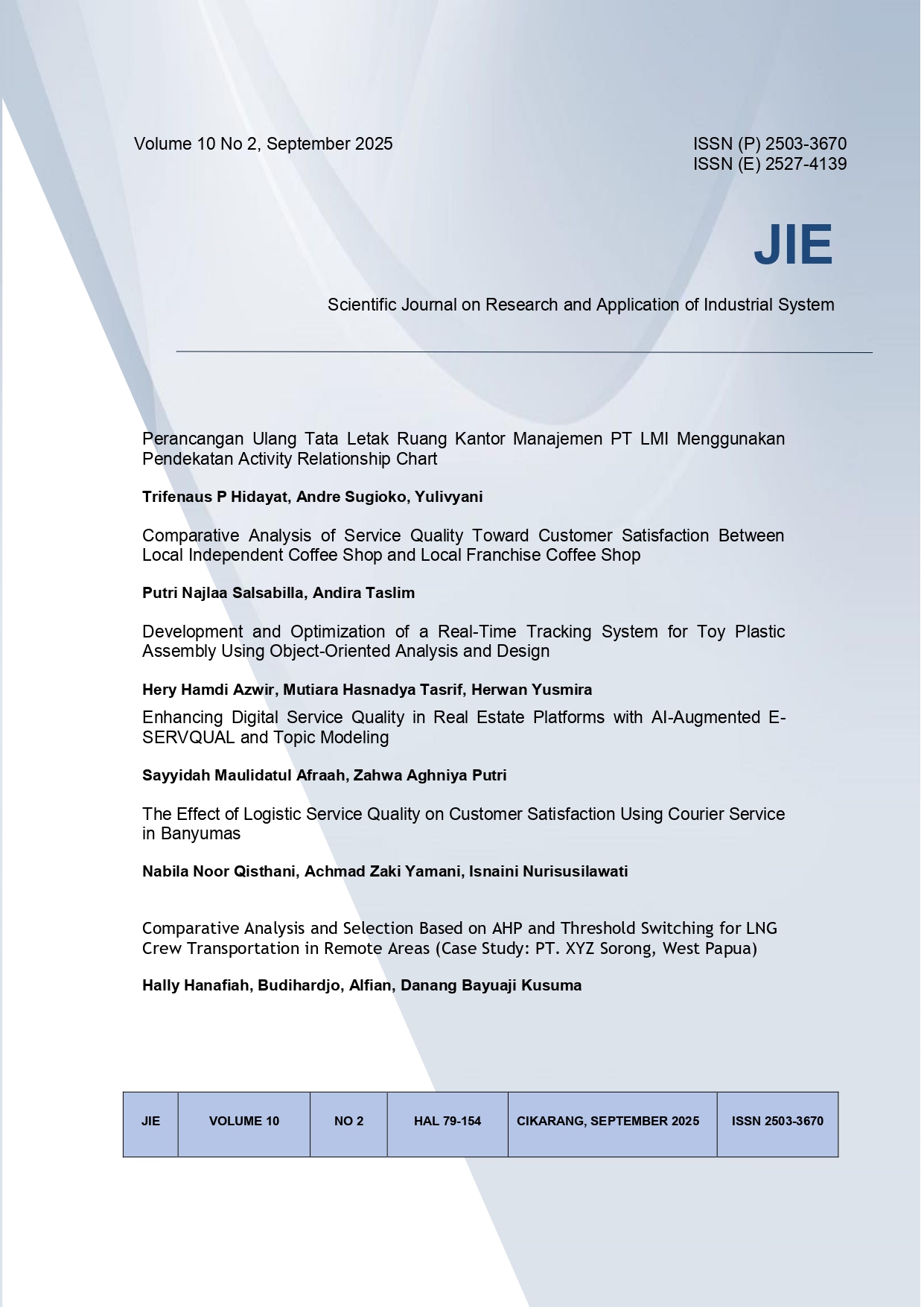
Enhancing Digital Service Quality in Real Estate Platforms with AI-Augmented E-SERVQUAL and Topic Modeling
DOI:
https://doi.org/10.33021/jie.v10i2.6744Kata Kunci:
e-servqual, property technology, real-estate marketplace, importance-performance analysis, core feature functionalityAbstrak
Digitalization has accelerated the growth of the property technology (proptech) industry, particularly in real estate marketplaces. As competition intensifies, platforms must enhance their digital service quality to meet the evolving needs of both users and agents. This study aims to develop an improvement model by focusing on the service dimension with the highest gap between importance and performance. A mixed-methods approach was employed using user reviews collected from Google Play, comprising a total of 400 reviews from the four most widely used real estate applications in Indonesia. The analysis considered importance (aspects most frequently discussed) and performance (aspects with the highest ratings). Thematic analysis of user and agent feedback was first conducted to construct the initial E-SERVQUAL model. This qualitative insight was then validated using Latent Dirichlet Allocation (LDA) and refined through Importance–Performance Analysis (IPA) to identify key service gaps. Results show that the System Availability dimension, particularly subdimension X19 (core feature functionality), exhibits the largest gap score of 3.464, placing it in the top-priority quadrant. LDA results reinforce this finding through Topic 6, which highlights complaints about app quality, especially regarding property advertisements and listing accuracy. To address this, the study proposes an AI-augmented core feature functionality model that integrates ad optimization, intelligent listing validation, and automated error detection to enhance operational efficiency, system accuracy, and overall user experience. The findings are particularly relevant for PT ABC, a new real estate platform currently facing declining performance. By benchmarking user feedback from top Indonesian property marketplaces, this study provides strategic insights for improving service quality, competitiveness, and digital transformation within the proptech ecosystem.
Referensi
1. Adiguzel, Z., Sonmez Cakir, F., & Altay Morgul, U. (2025). Effectiveness in the furniture industry: artificial intelligence, big data and sustainable design. Management Decision, ahead-of-p(ahead-of-print). https://doi.org/10.1108/MD-05-2024-1022
2. Afraah, S. M., & Aghniya, Z. P. (2025). Analisis Customer Journey Map untuk Meningkatkan Customer Experience pada Real Estate Marketplace. Tekinfo: Jurnal Ilmiah Teknik Industri dan Informasi, 13(2), 162–174. https://doi.org/10.31001/tekinfo.v13i2.2606
3. Afraah, S. M., Sutopo, W., & Rochani, R. (2023). The Role of Technopreneur and Innovation System to Increase the Adoption of Marketplace: A Case Study PT ABC in Indonesia. Proceedings of the 4th Asia Pacific Conference on Industrial Engineering and Operations Management Ho Chi Minh City, Vietnam.
4. Alaimo, C., & Kallinikos, J. (2022). Organizations decentered: Data objects, technology and knowledge. Organization Science, 33(1), 19–37.
5. Ariyanti, M., Trianasari, N., & Mulyani, L. S. (2023). E-Service Quality Analysis for Video Players and Editor App Using Sentiment Analysis and Topic Modeling. 2023 6th International Seminar on Research of Information Technology and Intelligent Systems (ISRITI), 116–122. https://doi.org/10.1109/isriti60336.2023.10467729
6. Armutcu, B., Majeed, M. U., Hussain, Z., & Aslam, S. (2025). The impact of digital voice of customer and product lifecycle management on Quality 4.0: moderating role of AI in SMEs. Journal of Manufacturing Technology Management, ahead-of-p(ahead-of-print). https://doi.org/https://doi.org/10.1108/JMTM-12-2024-0660
7. Bonina, C., Koskinen, K., Eaton, B., & Gawer, A. (2021). Digital platforms for development: Foundations and research agenda. Information systems journal, 31(6), 869–902. https://doi.org/10.1111/isj.12326
8. Braun, V., & Clarke, V. (2006). Using thematic analysis in psychology. Qualitative research in psychology, 3(2), 77–101.
9. Calvo, A. V., Franco, A. D., & Frasquet, M. (2023). The role of artificial intelligence in improving the omnichannel customer experience. International Journal of Retail & Distribution Management, 51(9/10), 1174–1194. https://doi.org/10.1108/IJRDM-12-2022-0493
10. Chatterjee, S., Nguyen, B., Ghosh, S. K., Bhattacharjee, K. K., & Chaudhuri, S. (2020). Adoption of artificial intelligence integrated CRM system: an empirical study of Indian organizations. The Bottom Line, 33(4), 359–375. https://doi.org/10.1108/BL-08-2020-0057
11. da Costa, M. C. R. (2024). the Importance of User Interface Design in Real Estate Platforms. International Seven Journal of Multidisciplinary, 1(1). https://doi.org/10.56238/isevmjv1n1-018
12. Dwivedi, Y. K., Pandey, N., Currie, W., & Micu, A. (2024). Leveraging ChatGPT and other generative artificial intelligence (AI)-based applications in the hospitality and tourism industry: practices, challenges and research agenda. International Journal of Contemporary Hospitality Management, 36(1), 1–12. https://doi.org/10.1108/IJCHM-05-2023-0686
13. Elmobark, N., El-ghareeb, H., & Elhishi, S. (2023). Measuring and Evaluating Frameworks for IT Service Quality in the IT Industry: A Comparative Study. 2023 International Conference on Artificial Intelligence Science and Applications in Industry and Society (CAISAIS), 1–6. https://doi.org/10.1109/CAISAIS59399.2023.10270071
14. Fahriza, I., Bisma, M. A., & Sumarna, D. L. (2023). Analisis Kualitas Pelayanan Bengkel Dealer Toyota Terhadap Kepuasan Pelanggan Pada Pt. Astra International Tbk - Auto 2000 Cabang Suci Bandung Menggunakan Metode Gap Analysis Dan Importance Performance Analysis (Ipa). Journal Transformation of Mandalika, e-ISSN: 2745-5882, p-ISSN: 2962-2956, 4(10), 567–584. https://doi.org/10.36312/jtm.v4i10.2094
15. Guo, Y., Wang, F., Xing, C., & Lu, X. (2022). Mining multi-brand characteristics from online reviews for competitive analysis: A brand joint model using latent Dirichlet allocation. Electronic Commerce Research and Applications, 53, 101141. https://doi.org/10.1016/j.elerap.2022.101141
16. Gussek, L., Grabbe, A., & Wiesche, M. (2023). Challenges of IT freelancers on digital labor platforms: A topic model approach. Electronic Markets, 33(1), 55. https://doi.org/10.1108/IJRDM-12-2022-0493
17. Halvorsrud, R., Kvale, K., & Følstad, A. (2016). Improving service quality through customer journey analysis. Journal of service theory and practice, 26(6), 840–867. https://doi.org/10.1108/JSTP-05-2015-0111
18. Helmi, S., Setyadi, B., Wedadjati, R. S., & Najmudin, M. (2024). Fintech in Islamic Finance and Technical Applications for Islamic Financial Institutions: A Systematic Literature Review Study. Kurdish Studies, 12(1), 4148–4172. https://doi.org/10.58262/ks.v12i1.298
19. Kalendralis, P., Eyssen, D., Canters, R., Luk, S. M. H., Kalet, A. M., van Elmpt, W., Fijten, R., Dekker, A., Zegers, C. M. L., & Bermejo, I. (2021). External validation of a Bayesian network for error detection in radiotherapy plans. IEEE Transactions on Radiation and Plasma Medical Sciences, 6(2), 200–206. https://doi.org/10.1109/TRPMS.2021.3070656
20. Kementerian Komunikasi dan Informatika Republik Indonesia. (2023). Buku Visi Indonesia Digital 2045. https://digital2045.id/bukuvid2045/
21. Kharisma, G. (2024). Data properti Indonesia: panduan lengkap. Tech in Asia. https://id.techinasia.com/data-properti-indonesia-panduan-lengkap
22. Kobylarz, T. J. A., & Kobylarz, E. J. (2023). Neurological Properties to Circumvent AI’s Error Reduction Impasse. Trends in Computer Science and Information Technology, 8(3), 61–72. https://doi.org/10.17352/tcsit.000070
23. Kuppan, K., Acharya, D. B., & Divya, B. (2024). Foundational AI in Insurance and Real Estate: A Survey of Applications, Challenges, and Future Directions. IEEE Access, 12, 181282 – 181302. https://doi.org/https://doi.org/10.1109/ACCESS.2024.3509918
24. Lai, C. D., Xie, M., Poh, K.-L., Dai, Y.-S., & Yang, P. (2002). A model for availability analysis of distributed software/hardware systems. Information and software technology, 44(6), 343–350. https://doi.org/https://doi.org/10.1016/S0950-5849(02)00007-1
25. Landis, J. R., & Koch, G. G. (1977). An application of hierarchical kappa-type statistics in the assessment of majority agreement among multiple observers. Biometrics, 363–374.
26. Lembaga Manajemen Aset Negara. (2023). Kinerja Pasar Properti H2 2023 dan Outlook Pasar Properti di Tahun Pemilu.
27. Li, H., & Suomi, R. (2009). A Proposed Scale for Measuring E-service Quality. International Journal of u- and e-Service, Science and Technology, 2(1), 1–10.
28. Matrunych, O. (2022). Automation of service management for residents based on Salesforce Platform [Ukrainian Catholic University]. https://er.ucu.edu.ua/server/api/core/bitstreams/b03d7777-1566-4356-9eba-2bf0eb658351/content
29. MIR, R. A., GULL, D. R., RAJA, D. R. R., & TAHIR, N. (2024). E-Service Quality in Public Procurement Platforms: A Critical Review Analysis. RAMEEZ and TAHIR, NIDA, E-Service Quality in Public Procurement Platforms: A Critical Review Analysis.
30. Muljono, W., & Setiyawati, S. (2022). Digital economy: the main power for digital industry in Indonesia. International Journal of Trade and Global Markets, 15(4), 423–444.
31. Ossai, C. I., & Wickramasinghe, N. (2023). Sentiments prediction and thematic analysis for diabetes mobile apps using Embedded Deep Neural Networks and Latent Dirichlet Allocation. Artificial Intelligence in Medicine, 138, 102509. https://doi.org/10.1016/j.artmed.2023.102509
32. Samosir, S. S. (2024). Terbukanya Penanaman Modal Asing Sektor Real Estate Berdasarkan Peraturan Presiden RI No 49 Tahun 2021 Tentang Perubahan Atas Peraturan Presiden RI Nomor 10 Tahun 2021. Innovative: Journal Of Social Science Research, 4(1), 9502–9519.
33. Silviu-Ionui. (2025). Reforming Real Estate Valuation for Financial Auditors With AI: An In-Depth Exploration of Current Methods and Future Directions. Audit Financiar, 23(1), 180–196.
34. Sinarta, S. Y., & Haryani, E. (2025). Analisis Kepuasan Pengguna pada Layanan E-commerce di Indonesia (Systematic Literature Review). JUSTIN (Jurnal Sistem dan Teknologi Informasi), 13(1), 135–147. https://doi.org/10.26418/justin.v13i1.86629
35. Sindi, E. (2024). Development of E-Servqual Dimensions for Banking. Praxis: Jurnal Sains, Teknologi, Masyarakat dan Jejaring, 6(2), 178–192. https://doi.org//10.24167/praxis.v6i2.11630
36. Siniak, N., Kauko, T., Shavrov, S., & Marina, N. (2020). The impact of proptech on real estate industry growth. IOP Conference Series: Materials Science and Engineering, 869(6), 62041.
37. Stanciu, V., & Rîndaşu, S.-M. (2021). Artificial intelligence in retail: Benefits and risks associated with mobile shopping applications. Amfiteatru Economic, 23(56), 46–64.
38. Wang, S., & Archer, N. P. (2007). Electronic marketplace definition and classification: Literature review and clarifications. Enterprise Information Systems, 1(1), 89–112. https://doi.org/10.1080/17517570601088380
39. Wulan, I., Safuan, S., & Erwin, E. (2024). Tinjauan Pustaka Dampak Keandalan E-Servqual Terhadap Kepuasan Pelanggan Dalam E-Commerce. Jesya (Jurnal Ekonomi dan Ekonomi Syariah), 7(2), 1911–1925. https://doi.org/10.36778/jesya.v7i2.1734
40. Yalçın, A., & Çatlı, Ö. (2024). A Study on the Electronic Service Quality of Digital Marketplaces in Real Estate Marketing. International Journal of Business and Economic Studies, 6(2), 110–128. https://doi.org/10.54821/uiecd.1489012
Unduhan
Diterbitkan
Terbitan
Bagian
Lisensi
Hak Cipta (c) 2025 Sayyidah Maulidatul Afraah, Zahwa Aghniya Putri

Artikel ini berlisensi Creative Commons Attribution-NonCommercial 4.0 International License.
Authors who publish with this journal agree to the following terms:
- Authors retain copyright and grant the journal right of first publication with the work simultaneously licensed under a Creative Commons Attribution License that allows others to share the work with an acknowledgement of the work's authorship and initial publication in this journal.
- Authors are able to enter into separate, additional contractual arrangements for the non-exclusive distribution of the journal's published version of the work (e.g., post it to an institutional repository or publish it in a book), with an acknowledgement of its initial publication in this journal.
- Authors are permitted and encouraged to post their work online (e.g., in institutional repositories or on their website) prior to and during the submission process, as it can lead to productive exchanges, as well as earlier and greater citation of published work (See The Effect of Open Access).