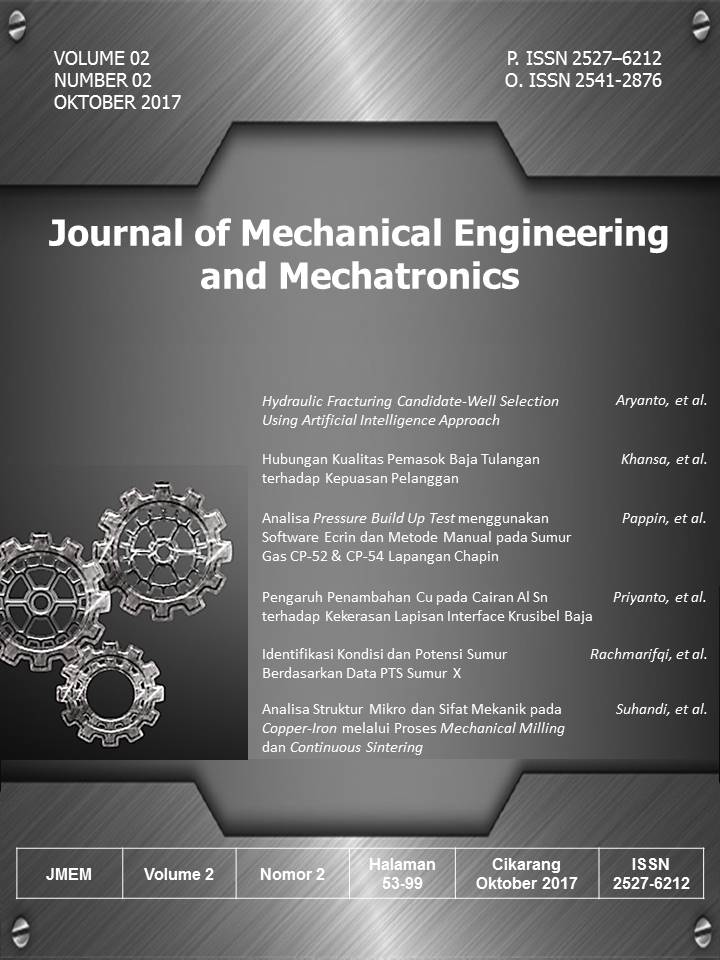
ANALISA STRUKTUR MIKRO DAN SIFAT MEKANIK PADA COPPER-IRON MELALUI PROSES MECHANICAL MILLING DAN CONTINUOUS SINTERING
DOI:
https://doi.org/10.33021/jmem.v2i02.327Abstract
Mechanical Alloying (MA) / Mechanical Milling (MM) is a process of processing of solid metal powders including the union and re-destruction of powder particles by using high-energy ball mill. The difference depends on whether material transfer is involved or not during processing. The study was conducted by analyzing the effect of the mechanical milling process by comparing the microstructure and mechanical properties of the copper-iron between the ones before milling (sample 1) and after milling for 2 hours (sample 2). The sample was made into a green compact cold pressing process with an emphasis system using mechanical mechanisms and dual emphasis techniques. Sintering process using continuous type machine with conveyor belt mesh and furnace type is muffle. After that cooled with natural water jacket process. Vicker hardness testing and strength testing (tensile strength test) is performed to determine the mechanical properties of copper-iron alloys that occur. The mean value of sample 1 hardness (before milling) was 39.8 HV. The mean value of sample hardness 2 (after milling) was 74.9 HV. The value of the yield strength (σ) of sample 1 is 17.597MPa, and the value of ductility (ε) is 0.119. The value of the yield strength (σ) of sample 2 is 18.547MPa, and the value of ductility (ε) is 0.073. The observation of micro structure was done to know the physiological surface of the alloy formed and to know the distribution of the composition. Observation of sample microstructure 1 shows solid phase formation ε (silver color) is an area of iron element formed with large size. Solid phase γ (orange color) is an area of copper element formed with large size. The visible elements are copper (Cu) and iron (Fe) which have a large percentage formed with large size (> 50 μm), and the pore is also large (> 50 μm). For carbon element (C), it looks gray, with a small amount. For other elements, such as zinc (Zn), phosphorus (P), and Tin (Sn), generally, they are at the grain boundary of iron (Fe) and copper (Cu) elements. Observation of sample microstructure 2 shows solid phase formation ε (silver color) showing iron area area formed with smaller size. The solid phase γ (white color) shows the copper element area formed with a smaller size. The elements seen are copper (Cu) and iron (Fe) with a small size (<50 μm), and small pores occur. From the test results and analysis showed that by shrinking the size of metal powder by milling for 2 hours can increase the hardness and yield strength of the product. Although the product becomes more brittle which is indicated by the decreased ductility value.References
Groover, Mikell P. 2010. Fundamentals of modern manufacturing: materials, processes and systems, 4th ed. USA : John Wiley & Sons, Inc.
Upadhyaya, G. S. 2002. Powder Metallurgy Technology. England : Cambridge International Science Publishing.
Suryanarayana, C. 2007. Mechanical alloying and milling. USA : Progress in Materials Science.
Los Alamos National Laboratory's Chemistry Division. 2001. A Periodic Table of the Elements. USA : Los Alamos National Laboratory.
Höganäs. 2013. Production of Sintered Components. Sweden : Höganäs AB.
ASTM. ASTM E3-01 Standard Guide for Preparation of Metallographic Specimens. USA : ASTM.
ASTM. ASTM E 407-99 Standard Practice for Microetching Metals and Alloys. USA : ASTM
Scott, David A. 1991. Metallography and microstructure of ancient and historic metals. Singapore : The J. Paul Getty Trust.
ASM International. 1998. Metals Handbook Desk Edition, Second Edition. ASM International Handbook Committee.
ASM International. 2004. ASM Handbook Volume 9 Metallography and Microstructures. ASM International Handbook Committee.
ASM International. 2000. ASM Handbook Volume 8 Mechanical Testing and Evaluation. ASM International Handbook Committee.
ASM International. 1998. ASM Handbook Volume 7 Powder Metal Technologies and Applications. ASM International Handbook Committee.
Davenport, W.G., M. King, M. Schlesinger, A.K. Biswas. 2002. Extractive Metallurgy of Copper, fourthedition. UK : Pergamon.
Ramakrishnan, P. 2013. Automotive applications of powder metallurgy. India : Woodhead Publishing Limited.
Ugarteche, Caroline Velasques. 2015. Journal Effect of Microstructure on the Thermal Properties of Sintered Iron-copper Composites. Brazil : Material research.
Morakotjinda, Monnapas. 2008. Journal Sintered Fe-Cu-C materials. Thailand : Journal science.
Downloads
Published
Issue
Section
License
Authors who publish with this journal agree to the following terms:- Authors retain copyright and grant the journal right of first publication with the work simultaneously licensed under a Creative Commons Attribution License that allows others to share the work with an acknowledgement of the work's authorship and initial publication in this journal.
- Authors are able to enter into separate, additional contractual arrangements for the non-exclusive distribution of the journal's published version of the work (e.g., post it to an institutional repository or publish it in a book), with an acknowledgement of its initial publication in this journal.
- Authors are permitted and encouraged to post their work online (e.g., in institutional repositories or on their website) prior to and during the submission process, as it can lead to productive exchanges, as well as earlier and greater citation of published work (See The Effect of Open Access).