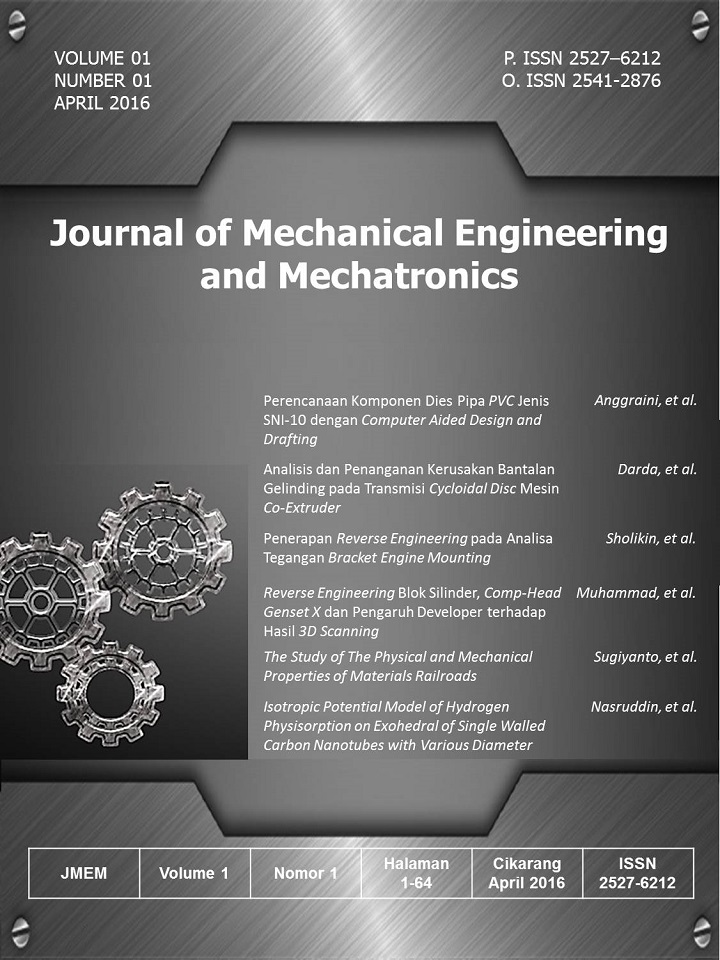
Reverse Engineering Blok Silinder, Comp-Head Genset X dan Pengaruh Developer terhadap Hasil 3D Scanning
DOI:
https://doi.org/10.33021/jmem.v1i01.34Abstract
Reverse engineering is a process in manufacturing, which aims to reproduce or recreate an existing model either component, sub-assembly, or product without using the data document design or picture of the existing work. Reverse engineering on the cylinder block and com.head conducted to determine the actual size and shape of the part is to create a 3D surface or solid using Geomagic software design x based stl-file of the 3D scanning using ATOS II. Critical part of this part is located in the combustion chamber and the position of head hole, so the tolerance used is ± 0.03 mm. By testing the differences between type A developer using the addition of an average dimension of 2 - 8 mm. With the addition of developer type B average dimension of 4 - 14 mm. While the difference between type A and type B by a margin dimensions of ± 0 - 11 mm, which developer A can affect the size of the work piece is better than the developer B.
Keywords. Reverse Engineering, Developer, Cylinder block, CAE, CAM.
References
Daftar Pustaka
http://bertozone.blogspot.com/2011/10/rendering-3d-desain-permodelan-grafis. Diakses tanggal 20 Mei 2015.
https://id.m.wikipedia.org/wiki/CAD. Diakses tanggal 14 Mei 2015.
http://www.cadanda.com. CAD Solutions, LLC. 2011. Computer-Aided Design & Applications. Diperoleh tanggal 12 Maret 2015.
Kumar, A., Jain, P.K. & Pathak, P.M. 2013. Reverse Engineering in Product Manufacturing: An Overview, Chapter39.Vienna : DAAAM International Scientific Book.
Peter hervay, dkk. 2012. CAD BOOK. Budapest: Budapest University
Prof.Dr.Suryana,M.si. 2010. Metodologi Penelitian - Model Praktis Penelitian Kuantitatif dan Kualitatif (Buku Ajar Perkuliahan) : Universitas Indonesia.
Rathone, N. & Jain, P.K. 2014. Reverse Engineering Applications in Manufacturing Industries: An Overview, Chapter 45.Vienna : DAAAM International Scientific Book.
Raja, Vinesh. 2008. Introduction to Reverse Engineering. UK: University of Warwick.
Vinesh Raja, and Kiran J. Fernandes. 2008. Reverse Engineering An Indutrial Perspective. UK: Springer Science + Business Media.
www.dimeg.poliba.it. Semi-Aautomatic Low Cost 3D Active Scanning Systems for Reverse Engineering. Diperoleh tanggal 12 Maret 2015.
www.scribd.com. Bambang WF. 2009. Materi Kuliah CAD/CAM. Diakses tanggal 29 Mei 2015
Downloads
Published
Issue
Section
License
Authors who publish with this journal agree to the following terms:- Authors retain copyright and grant the journal right of first publication with the work simultaneously licensed under a Creative Commons Attribution License that allows others to share the work with an acknowledgement of the work's authorship and initial publication in this journal.
- Authors are able to enter into separate, additional contractual arrangements for the non-exclusive distribution of the journal's published version of the work (e.g., post it to an institutional repository or publish it in a book), with an acknowledgement of its initial publication in this journal.
- Authors are permitted and encouraged to post their work online (e.g., in institutional repositories or on their website) prior to and during the submission process, as it can lead to productive exchanges, as well as earlier and greater citation of published work (See The Effect of Open Access).